

 7 hours ago
9
7 hours ago
9
PROTECT YOUR DNA WITH QUANTUM TECHNOLOGY
Orgo-Life the new way to the future Advertising by AdpathwayOff the coast of Monterey, California, a team of researchers is gearing up for its first dive of the day into the cold and choppy waters of the Pacific Ocean.
On the back deck of the boat, Ashley Kidd, a co-founder of the non-profit Sunflower Star Laboratory, gave the divers their final command: “Dive No 1 … stars in the water.”
The divers plunge into the water carrying plastic bags containing the true stars of this mission. On the ocean floor, they place the creatures inside specialized cages but keep the doors wide open. The goal is to encourage these alien-like predators to roam the seabed where they were once a crucial part of this underwater ecosystem.
“We have a star that decided to go for a walk today,” Kidd said, tracking the progress of one particularly mobile subject.
Kidd’s team is working to restore the sunflower sea star, a critically endangered marine invertebrate that looks less like a traditional starfish and more like something out of science fiction.
“They are a sea star, but the cool thing with these guys is they have more than five arms,” Kidd said. “They can have up to 24 arms, and we want to bring them back.”
A marine apocalypse in the Pacific
The underwater landscape here was once dominated by towering kelp forests. Often described as the redwoods of the sea, kelp can grow taller than a 10-story building at rates of up to 2ft per day. These dense aquatic canopies form a critical habitat for thousands of marine species and contribute to the ocean’s ecological engine that produces roughly half of the oxygen on Earth.
They are also a crucial defense against global heating. Worldwide, kelp forests sequester approximately 200m tons of carbon dioxide every year by pulling large amounts of planet-warming emissions out of the atmosphere, which they use to grow.
Yet over the past decade, these vital underwater sanctuaries have been decimated along the Pacific coast.
Beginning around 2013, a marine heatwave fueled by the climate crisis raised water temperatures across the west coast. The warm water accelerated the spread of sea star wasting syndrome, a disease that literally dissolved the bodies of sunflower sea stars, wiping out more than 90% of the Pacific population.
“There were 6bn sunflower stars from Alaska down to Baja California,” said Reuven Bank, a co-founder of the Sunflower Star Laboratory. “Six billion with a B.”
When the stars disappeared, the delicate ecological balance dissolved with them.
“95% of our kelp forests have disappeared in the last 10 to 12 years,” Bank said.
The ‘halo of fear’
Sunflower sea stars feed on purple sea urchins. With the stars gone, the urchin population exploded. Armies of these spiky grazers carpeted the seafloor, ravenously devouring the roots and stalks of the kelp until vast underwater forests were reduced to barren deserts.
To reverse the damage, researchers are racing to restore what they call the “halo of fear”.
“Urchins and other grazers smell a sunflower star coming and they take off in fear,” Bank said. “They hide more, they eat less, up to 16ft in every direction. They eat urchins and they scare urchins.”
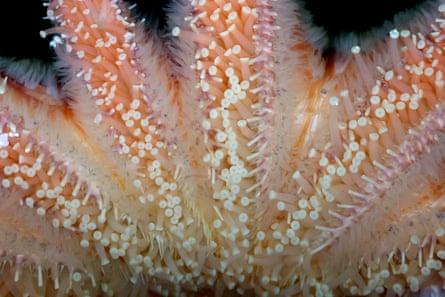
Back at the lab, Bank demonstrated just how voracious a healthy star can be.
“So this ridiculous alien monster here is Titan,” Bank said, placing a purple urchin directly on to the sprawling arm of a sea star the size of a large dinner plate. “That urchin’s a goner. He’s funneling it straight to his mouth.”
Using hundreds of tiny tube feet like a hydraulic system, a single sunflower star can devour three or four urchins a day. Their power as a deterrent is even greater, as the mere scent of a star forces urchins into hiding, giving young kelp a fighting chance to take root and grow.
Rebuilding an ecosystem from scratch
Inside the lab’s breeding facility, researchers are pioneering complex marine husbandry techniques to raise a new generation of sea stars in temperature-controlled tanks. The work is crucial as the wild population along the Pacific coast has reached catastrophic lows.
“The known number of sunflower stars in Monterey Bay is zero,” said Bank.
Their field experiments mark a first for California. By briefly releasing lab-raised stars on to the seafloor to study their movement and monitor the behavioral reactions of local urchins, scientists are gathering the baseline data needed for full-scale wild reintroduction.
If the trials succeed, the team hopes to permanently reintroduce the species to Monterey Bay within the next few years, setting off a chain reaction that could one day heal a devastated coastline.
“Restoring the sunflower star,” Bank said, “is the single most important step you can take to saving our beleaguered kelp forests here in California.”
Climate Central is an independent group of scientists and communicators who research and report the facts about our changing climate and how it affects people’s lives



















 English (US) ·
  French (CA) ·