

 10 hours ago
11
10 hours ago
11
PROTECT YOUR DNA WITH QUANTUM TECHNOLOGY
Orgo-Life the new way to the future Advertising by AdpathwayListening to birdsong is one of life’s great joys, but when researchers heard a particular tune emerging from a tree in a Buenos Aires park, they were especially jubilant. This arrangement was among those chirped by the local rufous-collared sparrows in the 1960s, but had since disappeared from the area.
That was until scientists created a computer-generated rendition, curious to find out if birds might consider it realistic enough to imitate. Less than three months later, a local avian resident began to copy parts of the song.
There is a growing recognition of birdsong’s importance to conservation, and of the need to better understand how birds learn to sing. If an individual sings well, and in a familiar “dialect”, they are better placed to find a mate, defend their territory and ultimately survive.
If a species’ population declines, however, there are fewer opportunities for fledglings to become good singers. Birds can begin to tweet abnormally or mistakenly learn the songs of other species, jeopardising their chances of breeding.
Male birds are in a better position to attract a mate if they can sing well – which, broadly speaking, means their song is complex, sung consistently and well performed. “If your song requires a lot of energy you might have to be in quite a good condition to sing it,” says Rebecca Lewis, a conservation scientist at Chester Zoo.
“When people talk about biodiversity, we’re always talking about genes, about genetic material,” says Gabriel B Mindlin, professor of physics at the University of Buenos Aires, who co-authored the study on rufous-collared sparrows, and whose work is featured in a Guardian-produced documentary, Dream of Birds.
But animals’ learned behaviour or culture, such as birdsong, is also an essential part of their population, says Mindlin.
The rufous-collared sparrow is not considered vulnerable globally, but researchers hope that synthetic recordings could help teach birdsong to other species whose populations are dwindling, allowing conservationists to tutor individuals where real-life recordings do not exist.
About 4,000 of the world’s 10,000 bird species are songbirds (or oscine passerines), such as finches, sparrows and blackbirds, which generally have complex songs that are at least partly learned from other individuals. Their songs are hugely diverse, though separate research on the wider group of passerine group of birds, which incorporates songbirds, has identified common “motifs” or building blocks: three types of trill, three types of whistle, chaotic notes and harmonic notes.
The way that birds use these motifs reflects the environment in which the birds evolved. Flat whistles are more likely to be sung by birds in tropical rainforests where sound must travel through dense vegetation. Complex motifs, such as ultrafast trills, are more common in temperate regions where birds tend to communicate at closer range.

The song studied by Mindlin was recreated based on hand-drawn annotations of rufous-collared sparrow songs that were made in the 1960s. Each song consists of a trill, which is consistent among individuals in the same region, and a theme, which varies. Some of the themes recorded decades ago are still sung by the local birds, but others have died out.
It is not clear why the song studied by Mindlin had disappeared, though he notes the population of birds in the park had declined.
Birds’ songs can change naturally over time – for example, birds might make errors when learning songs, which then can become imprinted in future renditions. Human encroachment and population declines can also cause dramatic changes.
Songbirds learn from other members of their species - such as a father or neighbours – which results in local groups developing their own dialects. The window for learning varies from a few weeks to a lifetime. Some species also have an innate level of knowledge.
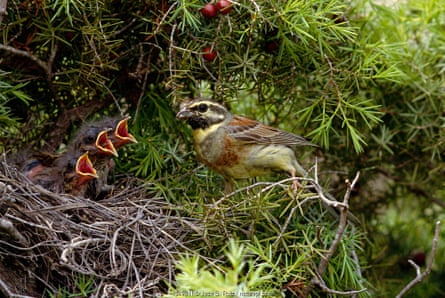
“There’s such a diversity in songbirds in how they learn,” says Sarah Collins, associate professor of animal behaviour at the University of Plymouth, who studied a group of cirl buntings that were translocated from Devon to Cornwall as part of a conservation project.
Initially, the birds produced abnormal songs that were squeaky and slow, and far less diverse than those of the source populations in Devon. “They didn’t have the richness of sound,” says Collins. Eight years later, however, their songs had returned to normal.
A few of the chicks were played recordings of cirl sounds, though not all. The study suggests that recovery of song is possible, though it is unclear if other species would bounce back in the same way. Cirl buntings are born with knowledge of the elements that make up the “notes” used in their songs, says Collins. “What they learn is how to put those elements together,” she says.
Some songbird species have a similar genetic underpinning and so may also be able to recover their songs, but others do not. Either way, Collins recommends a tutor to help other birds that are being translocated.
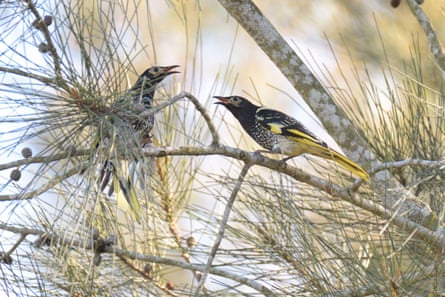
A separate study in Australia tracked regent honeyeaters that were bred in zoos to boost a critically endangered wild population that had fallen to about 250 individuals. Interacting with just two wild-born male “tutors” helped the zoo-bred birds to learn to sing the wild songs. Thereafter, zoo-bred males that had learned the traditional songs went on to tutor the next generation.
“Sometimes birds don’t learn very well from CDs or just playbacks. They need some sort of interaction,” says Collins.
Bringing wild birds into captivity to teach hand-reared chicks could cause huge distress and bring disease, however, risking the health of individuals from an already endangered population. It is possible that AI could help provide live tutoring in the future.
Dialect is also important. Past translocation projects have shown that birds are slower to match if they do not sing in the same dialect. “Birds with mismatched songs don’t pair quite as quickly or do quite as well once they’re paired,” adds Lewis. Familiarising birds with songs of their destination can help to mitigate this.
A huge volume of birdsong is now being recorded and uploaded into databases, including by a growing number of hobbyists interested in birdwatching, says Mindlin. “One day we’ll be grateful to have all those records,” he says. “I don’t think we still have an idea that really we have to register dialects and communication systematically.”
In Buenos Aires, the song from the 1960s can still be heard. “It’s still being sung by just a few individuals, pretty close to where we inserted it,” he says, though only time will tell how long it persists.
Find more age of extinction coverage here, and follow the biodiversity reporters Rebecca Ratcliffe, Phoebe Weston and Patrick Greenfield in the Guardian app for more nature coverage.




















 English (US) ·
  French (CA) ·