

 13 hours ago
5
13 hours ago
5
PROTECT YOUR DNA WITH QUANTUM TECHNOLOGY
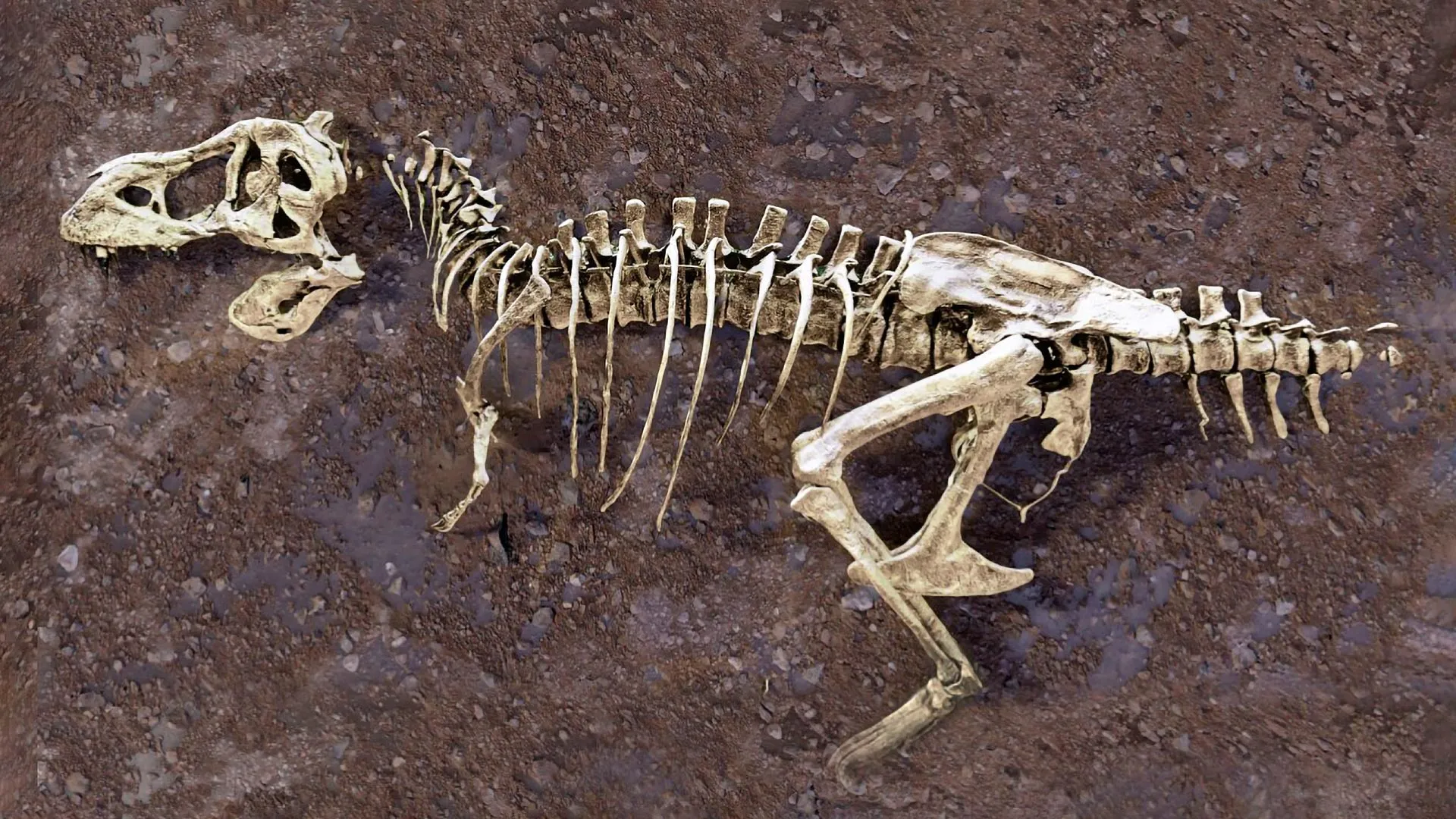
Orgo-Life the new way to the future Advertising by AdpathwayScientists have taken the temperature of a Tyrannosaurus rex, 66 million years after it lived. A UCLA-led team analyzed chemical bonds preserved in fossil tooth enamel and estimated that the predator ran at about 97 degrees Fahrenheit (36 degrees Celsius). That is similar to modern elephants and close to the human range. The results were published Sept. 16 in Science Advances.
The number fills a long-standing gap. Growth rates, bone structure and fossil locations have increasingly pointed to a warm-blooded T. rex, but a firm number had eluded scientists. "No one's been able to make a temperature measurement like this before," study co-author Robert Eagle, a UCLA geobiologist, said in a UCLA release on the T. rex temperature study.
The result also helps explain behavior. An animal that makes its own body heat can stay active without depending on the sun, which fits the picture of T. rex as an active predator or scavenger. It may also help explain how tyrannosaurs lived in places too cold for most reptiles.
How Scientists Read a Thermometer Locked in Teeth
The method is called clumped isotope paleothermometry. Tooth enamel contains rare heavy forms, or isotopes, of carbon and oxygen. How often those heavy atoms bond to each other while the enamel forms depends partly on temperature. Cooler conditions produce more of these clumped bonds, and warmer conditions produce fewer.
To read that signal, lead author Randon Flores and Eagle used a dental drill to collect tiny amounts of enamel and dissolved the powder in phosphoric acid. That released carbon dioxide gas carrying the bonds, which a mass spectrometer then measured. Enamel works well because its large, durable crystals resist chemical change over millions of years better than bone does.
The approach itself is not brand new. Eagle and colleagues used clumped isotopes in 2011 to estimate body temperatures of large Jurassic sauropods at 36 to 38 degrees Celsius. What changed for T. rex was the sample size. The team cut the amount of material needed by roughly 90 percent, which persuaded the Natural History Museum of Los Angeles County to allow sampling from Thomas, its most complete T. rex skeleton, excavated from Montana's Hell Creek Formation.
The researchers also built in a check. A crocodilian from the same Hell Creek site came out at about 86 degrees Fahrenheit (30 degrees Celsius), far cooler than T. rex. If burial chemistry had altered both fossils the same way, the two readings should have been similar. Their difference suggests the signals reflect real biology.
Warmer Than a Reptile, Cooler Than a Bird
The estimate places T. rex between two familiar groups. Modern cold-blooded reptiles typically run about 82 to 86 degrees Fahrenheit (28 to 30 degrees Celsius), while most birds, the descendants of dinosaurs, often run 104 to 109 degrees Fahrenheit (40 to 43 degrees Celsius), according to Eagle.
"The temperature is about what I would have guessed," Eagle said, describing it as higher than a reptile or a slow mammal like a sloth, but lower than a bird.
Not everyone expected that number. "I almost would have expected a higher body temperature," Jasmina Wiemann, a paleobiologist at Johns Hopkins University who was not involved in the study, told The Associated Press. Based on her earlier research on dinosaur metabolism, she thought the predator could have run a few degrees hotter, closer to birds. That difference is a reminder that different methods can yield different estimates.
The temperature also points to range. Using paleoclimate models, the team reconstructed where an animal with a 97-degree body could have survived about 66 million years ago, and the answer stretched from Mexico to Alaska. The Cretaceous climate was roughly 11 to 25 degrees Fahrenheit warmer than today, yet winters in ancient Alaska would still have been hard on cold-blooded animals. Tyrannosaur fossils have been found there, but paleontologists have not found fossils of lizards, turtles or crocodiles from Cretaceous Alaska, said co-author Alessandro Chiarenza, a paleontologist at University College London.
What the Study Shows and What It Does Not
The study is peer-reviewed, but its sample is small. It covers only a few teeth, so it gives a snapshot rather than a species-wide average. Enamel also records the temperature at the time it formed, not across the animal's whole life.
Reports describe the sample slightly differently. UCLA says the museum provided portions of two of Thomas's teeth, while the AP reported readings from three teeth. The average of about 97 degrees is consistent across the coverage.
The finding does not settle the metabolism of all dinosaurs. Dinosaurs were an enormously diverse group, and researchers still debate where different lineages fell on the spectrum from cold-blooded to warm-blooded. Scientists say it will be important to test the method on other dinosaurs, and co-author Aradhna Tripati, a UCLA geochemist, told the AP the findings could also shed light on what prey T. rex needed to fuel its metabolism.
The work was supported in part by National Science Foundation grants. The museum weighed the scientific value against permanent damage to an irreplaceable fossil before allowing the sampling. "Sacrificing small portions of two teeth to learn about T. rex's body temperature is definitely worth the trade-off," said Luis Chiappe, curator of the museum's Dinosaur Institute.
The bottom line: T. rex appears to have run at a body temperature close to ours, which supports the image of an active, warm-blooded predator able to range into cold regions. The estimate comes from a small sample, and more measurements across specimens and species will show how typical it is.
What Readers Want to Know
What was T. rex's body temperature?
The study estimates about 97 degrees Fahrenheit (36 degrees Celsius), similar to elephants and close to humans.
How can scientists measure the temperature of an extinct animal?
They measure how often heavy carbon and oxygen isotopes bonded together in tooth enamel. That bonding rate depends on the temperature at which the enamel formed.
Does this prove T. rex was warm-blooded?
It provides direct chemical evidence of a body temperature well above that of modern reptiles, which supports earlier evidence that T. rex was warm-blooded.
Were all dinosaurs warm-blooded?
Not necessarily. Dinosaurs were diverse, and scientists still debate the metabolism of different groups.
How did researchers rule out chemical changes after burial?
They compared T. rex with a crocodilian from the same site. The crocodilian read much cooler, about 86 degrees Fahrenheit.
What does the temperature say about where T. rex lived?
Paleoclimate modeling suggests a T. rex with that body temperature could have lived from Mexico to Alaska, and tyrannosaur fossils have been found in Alaska.
How many teeth were tested?
UCLA says it sampled portions of two teeth from the museum specimen known as Thomas, while the AP reported readings from three teeth.
© 2026 NatureWorldNews.com All rights reserved. Do not reproduce without permission.


















 English (US) ·
  French (CA) ·