

 4 months ago
92
4 months ago
92
PROTECT YOUR DNA WITH QUANTUM TECHNOLOGY
Orgo-Life the new way to the future Advertising by Adpathway What’s she looking at? Carla huddles over the eggs, 11:42am, 23 April 2026 (photo from the National Aviary snapshot camera at Univ of Pittsburgh)
Friday, 24 April 2026
Since Thursday morning Carla has been very fidgety on the eggs, often hunched over them with her back feathers raised and her wings in a protective position. Before she settles down she rocks side to side and peers under her belly.
What is she looking at?
Carla can hear one or more of her chicks tapping inside their eggshells, working their way toward making a pip and ultimately hatching.
[From inside the egg] Hatching is an energetically demanding process. The young chick uses its egg tooth, a small knob on top of its bill, to hammer a pip (hole) in the egg. It periodically works to break the egg around the pip area, but rests much of the time. The entire process from initial pip to hatch can take up to 72 hours. All the eggs in a Peregrine Falcon clutch generally hatch “synchronously” (within 24–48 hours for a clutch of 4).
— Richmond Peregrine Falconcam FAQAs expected, it is very hard to see what the eggs look like. Often the only way to know a chick has hatched is to see a broken eggshell beyond Carla’s sheltering body.
Here’s what a “hatch” looks like (this was in 2024): Wet chick, pipped egg (white spot), discarded eggshell.
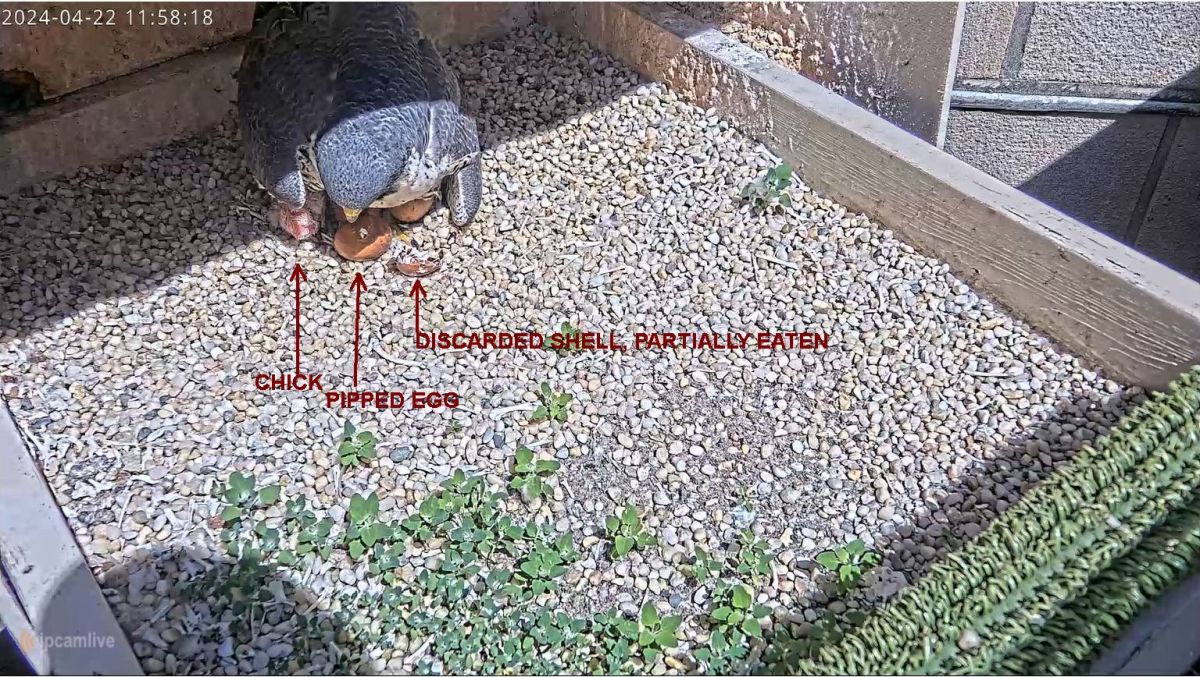 Some telltale signs of Hatch Day: Wet chick, pipped egg, broken eggshell, 22 April 2024 at the Pitt peregrine nest (photo from the National Aviary falconcam at Univ of Pittsburgh)
Will today be Hatch Day at the Pitt peregrine nest?
Stay tuned to the National Aviary falconcam at the Cathedral of Learning to find out.



















 English (US) ·
  French (CA) ·