

 1 day ago
10
1 day ago
10
PROTECT YOUR DNA WITH QUANTUM TECHNOLOGY
Orgo-Life the new way to the future Advertising by AdpathwayDiplodocus, the long-necked giant long considered a signature dinosaur of the American West, also lived in what is now Spain about 150 million years ago, according to a study published September 15, 2026, in the Journal of Vertebrate Paleontology. The fossils are the first confirmed remains of the genus found outside the western United States.
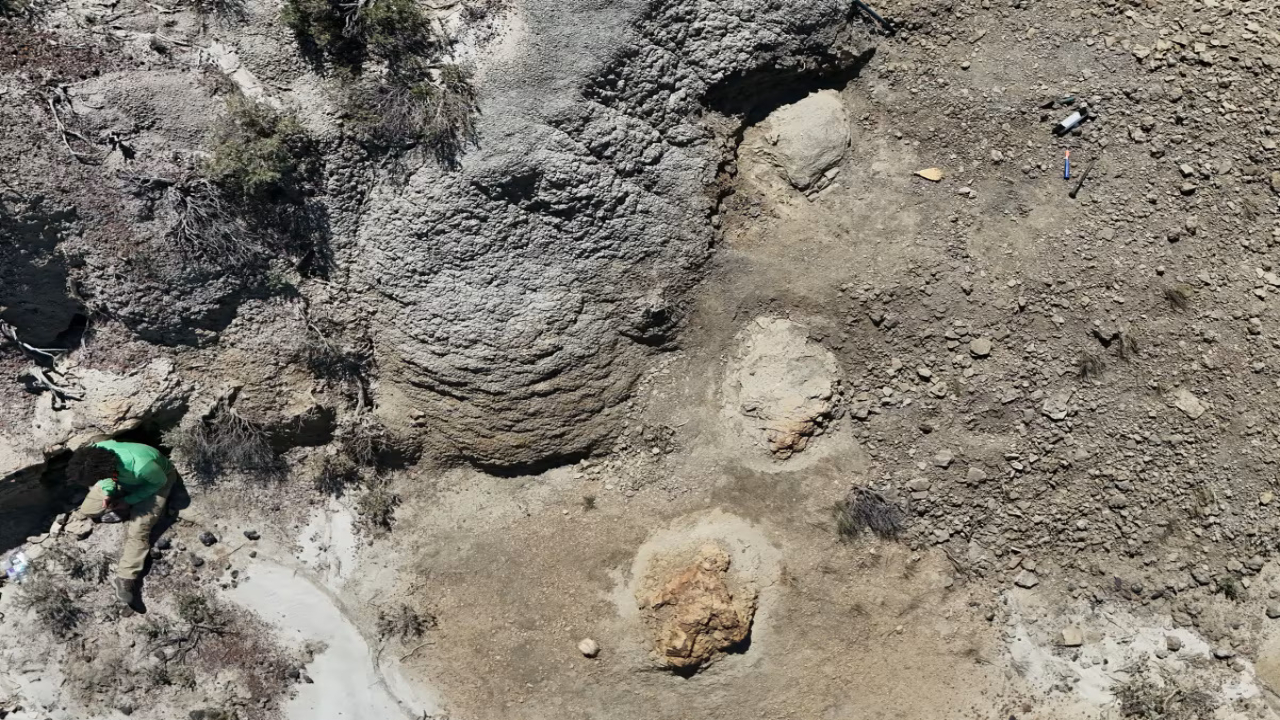
Paleontologists with the Dinópolis Foundation in Teruel identified 14 well-preserved tail vertebrae and several chevrons, bones beneath the tail that helped support blood vessels and muscles, at the La Tejería site near the village of El Castellar in eastern Spain. The animal was about 82 feet (25 meters) long, comparable in size to its North American relatives.
Until now, Diplodocus fossils from the Late Jurassic were known only from the Morrison Formation of the western United States. Finding the genus in Europe suggests animals could move between the two continents while the Atlantic Ocean was still opening, and that the distribution of giant sauropods was more complicated than the fossil record had shown.
From Mountainside Clue to Confirmed Identification
The find began with a tip. Study co-author Alberto Cobos, managing director of the Dinópolis Foundation, told Live Science that a friend thought he had spotted bones on a mountainside, and a visit to the site the same day turned up sauropod vertebrae.
The bones share features associated with Diplodocus, including large cavities where air sacs would have extended into the bone and deep grooves along the underside of the tail vertebrae. First author Sergio Sánchez Fenollosa, a doctoral student at the foundation, said the team noticed strong similarities to North American diplodocines early in the study. With each new result, he said in a statement, it became clearer that "we were looking at a Diplodocus."
The researchers could not determine which species the Spanish animal belongs to. That will require more complete remains.
A Possible Land Bridge Across a Young Atlantic
Between about 195 million and 170 million years ago, the supercontinent Pangaea broke apart as the Atlantic Ocean began to open. By the Late Jurassic, the ocean was far narrower than today, and the continents were not as isolated as they look on a modern map.
One possible route for Diplodocus into Iberia was a land bridge connecting what is now Newfoundland with the Iberian Peninsula. Sánchez Fenollosa told Live Science that this interpretation is supported by both fossil and geological evidence. Live Science described the Spanish specimen as some of the strongest fossil evidence yet that dinosaurs could move between North America and Europe during the Late Jurassic.
Land bridges have shaped animal movement many times in Earth's history. The best-known example is the Bering Land Bridge between Asia and what is now Alaska, used by early humans. Earlier research suggests a Bering connection also existed around 68 million years ago and may have let an Asian ancestor of Tyrannosaurus rex reach North America.
Measuring an 82-Foot Giant
At about 82 feet long, the Spanish Diplodocus would stretch most of the length of a regulation NBA basketball court, which runs 94 feet. Much of that length came from an extremely long neck and a whip-like tail.
The American side of the story is well documented. According to the National Park Service guide to the Morrison Formation, the formation was deposited between about 157 million and 150 million years ago across rivers, floodplains, lakes, and other environments. It has yielded famous sauropods including Apatosaurus, Brontosaurus, Camarasaurus, and Diplodocus.
Americans have been meeting Diplodocus for more than a century. The famous "Dippy" skeleton debuted at the Carnegie Museum of Natural History in Pittsburgh in the early 1900s, and replicas were sent to England, France, Spain, Argentina, and Russia. The museum's paleontologist Earl Douglass later found the Carnegie Quarry in 1909 near Jensen, Utah, now part of Dinosaur National Monument, where visitors can see fossils left in place in the Quarry Exhibit Hall.
Open Questions for Paleontologists
The finding rests on a partial skeleton, which limits what it can show. The tail bones support the genus identification, but without more of the skeleton the team cannot say whether the Spanish animal was a known North American species or a new one. The land bridge is a proposed route, not a proven one, and the timing of any crossing remains unknown.
Sánchez Fenollosa said more complete specimens will be essential to determine which Diplodocus species lived in Europe. Even for such an iconic dinosaur, he told Live Science, "there are still many unanswered questions." Cobos described the El Castellar animal as another of the giant sauropods of the Spanish Jurassic.
For dinosaur fans in the United States, the Morrison Formation can be seen in many National Park Service units, including Dinosaur National Monument on the Colorado-Utah border and Arches National Park in Utah. Fossils in national parks are protected, so visitors who spot bones should photograph them, note the location, and report them to park staff rather than removing them.
The full paper is available through the Journal of Vertebrate Paleontology.
What Readers Want to Know
What was discovered in Spain?
Paleontologists identified 14 tail vertebrae and several chevrons from a Diplodocus near El Castellar in Teruel province, the first confirmed remains of the genus outside the western United States.
How old is the fossil?
The remains date to the Late Jurassic, about 150 million years ago, the same general age as North American Diplodocus fossils.
How big was this Diplodocus?
Researchers estimate it was about 82 feet (25 meters) long, similar to its relatives from the western U.S.
How did Diplodocus reach Europe?
Researchers suggest it may have crossed a land bridge linking what is now Newfoundland and the Iberian Peninsula while the Atlantic Ocean was still narrow.
Is it a new species?
Unknown. The partial skeleton supports the genus identification, but more complete bones are needed to identify the species.
Where can I see Diplodocus-age fossils in the U.S.?
The Carnegie Museum of Natural History in Pittsburgh displays the famous "Dippy," and Dinosaur National Monument preserves the historic Carnegie Quarry in its Quarry Exhibit Hall.
© 2026 NatureWorldNews.com All rights reserved. Do not reproduce without permission.

















 English (US) ·
  French (CA) ·