

PROTECT YOUR DNA WITH QUANTUM TECHNOLOGY
Orgo-Life the new way to the future Advertising by AdpathwayAdam Cruickshank is a team member at Birding Ecotours and the host of The Birding Life Podcast. He is based in South Africa and spends much of his time exploring African birding destinations, sharing personal field experiences, and working with local guides across the continent.
Having just returned from a weeklong trip to Kruger National Park, I can confirm that the above statement is true. As soon as the trip ended, I was already starting to plan my next visit to this special place.
Situated in northeastern South Africa along the borders of Mozambique and Zimbabwe, Kruger National Park is one of Africa’s greatest wildlife destinations. Home to more than 550 bird species and around 148 mammal species, the park has captivated birders and nature lovers alike for well over a century.
So why do people keep coming back to this park?
The biggest reason is that you will never finish Kruger.
I have had the opportunity to speak to many people around campfires at the end of long days exploring the park. Some have been visiting Kruger for decades. Yet one theme comes up repeatedly. Every visit to the reserve is different. You never know what you will see, and there is always the possibility of seeing something you have never seen before.
When I visited the reserve a few weeks ago, my main target was birds. We got to see many sought-after species such as Racket-tailed Roller, Böhm’s Spinetail, and White-crowned Lapwing. Yet the highlight of the trip was not even a bird.
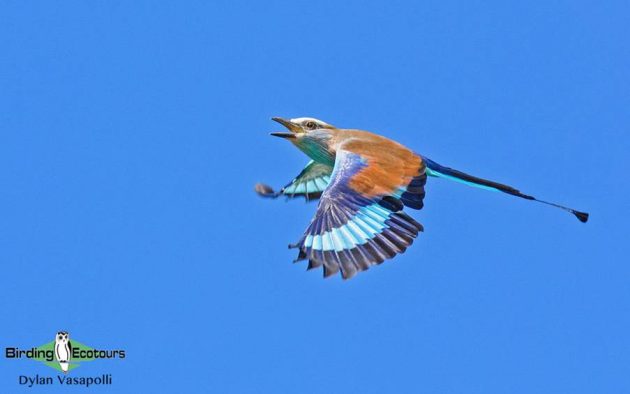
A Racket-tailed Roller in flight. This striking species is one of the many reasons birders return to Kruger National Park time and time again. (photo Dylan Vasapolli)
After a slow lunch overlooking the Mphongolo River, we decided to take a leisurely drive back to the Punda Maria camp, where we were staying. We chose a dirt road that wound alongside the river. But nature had other plans. We came around a corner and found a large group of Elephants feeding in the road. You do not mess with Elephants, so we turned around and headed back to the less desirable tar road.
Even though there were hundreds of Buffalo alongside the road, with flocks of Yellow-billed Oxpeckers moving between them, this road was proving far less productive than the one we had left behind.
But this was about to change.
We were driving through the heat of the midday sun when we noticed an animal crossing the road in the distance. At first, we could not quite make out what it was. As we slowly drew closer, we realized we were looking at a Caracal.
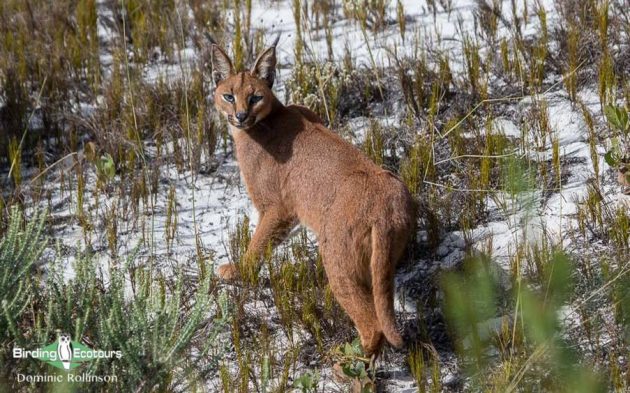
Caracals are seldom seen in Kruger National Park, making every sighting a truly memorable one. (Photographed in the Western Cape by Dominic Rollinson).
This is an animal that not many people get to see in Kruger. Our hearts were racing as we tried to find words for what we were witnessing. The Caracal appeared to be chasing a Nile Monitor. As we waited, it moved alongside the car. Then, just a few meters from my window, it stopped and looked straight at me. Eye to eye with one of the park’s most beautiful and elusive predators.
Moments later it disappeared into the bushveld, leaving me wondering whether what I had just experienced had really happened.
This is what keeps people coming back again and again. You simply never know what you are going to see. No matter how much you have already experienced, there is an almost endless number of encounters still waiting for you.
But Kruger is even more than that.
Kruger engages all your senses.
This is much more difficult to put into words. No painter could ever fully capture the fullness of the landscapes found within the park. From wide open savannas to secretive, tree lined rivers, Kruger offers a remarkable diversity of habitats, each with its own character and beauty. The park has a way of leaving you feeling that there is always more to take in. Even when you think you know it well, the changing seasons and shifting weather continue to shape it, chiselling its landscapes just a little more. This ever-evolving park has been shaped for centuries and is still being shaped today, allowing the curious explorer to never fully grasp it all. That, perhaps more than anything else, is part of its magic.
What sticks most in my memory is something I cannot show you in a photograph or fully explain with words.
Kruger has a smell.
As soon as you arrive at the gate and stand beneath the thatch, there is a scent that is uniquely Kruger. That same smell drifts through the camps. Even now, weeks after returning home, I can close my eyes, take a deep breath, and my mind is transported straight back to the park.
When that memory begins to fade, I know it is time to return and imprint that scent on my memory once again.
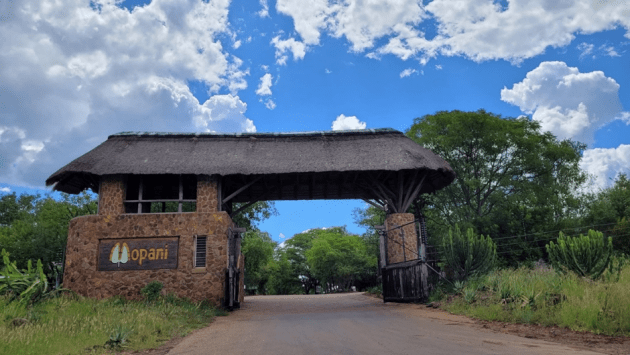
The thatched entrance to Mopani Rest Camp (photo by Tyron Dall)
But it goes even deeper than that. Kruger connects in a way that goes beyond the physical senses. There is a deep longing within the very essence of who we are that Kruger somehow seems to connect with. It brings a sense of serenity and connection, a feeling that, for just a little while, this is exactly where you are meant to be. It is difficult to explain, but anyone who has spent time in Kruger will probably know exactly what I mean.
I can still vividly remember how sad I felt the first time I returned from Kruger and had to wash my car. The dust somehow connected me back to the park, and watching it disappear felt as though a small part of me was being washed away too.
Kruger grabs hold of you, and it has a way of never letting you go.
Kruger offers something that is unique among many of Africa’s major parks. You can self-drive. The extensive, well-developed road network makes this possible for almost anyone.
I have been on game drives in other reserves where many of the people in the vehicle had little or no interest in birds. You could almost feel the tension every time you asked to stop for one, especially if it was an LBJ, or “little brown job.”
Kruger allows you to set your own pace and stop whenever you want. I have been rewarded countless times simply by pulling over and spending time with a mixed bird party. Sometimes there was not much to see, but other times those stops produced some of the best birding of the trip.
For bird tour guides, this is also a huge advantage, as they are not restricted by having to share vehicles with guests whose interests may be very different.
This freedom does have a downside.
Popular sightings can become crowded, particularly in the southern part of the park. Southern Kruger offers exceptional game viewing, so it is no surprise that it attracts many visitors. You always know when one of the Big Five has been spotted because there is often a long line of cars jockeying for position.
For those looking for a quieter experience, the north offers space, peaceful roads, and a real sense of wilderness. There are times when you can drive for long stretches without seeing another vehicle.
One of the amusing things about birding in southern Kruger is that if you stop for a bird, another vehicle will often pull up beside you to ask what you have found. Prepare yourself for the poorly disguised look of disappointment when you tell them it is a bird, especially if it happens to be a rather drab LBJ.
What I personally love about Kruger is that it offers comfort without losing the wilderness experience. Some people argue that the park is too developed, but I love the fact that I can enjoy a good, affordable meal in a restaurant before returning to an air-conditioned room at the end of the day. In summer, that air conditioner is worth its weight in gold.
The camps themselves are also part of what makes Kruger so special. Not only because of the facilities they offer, but because they seem to break down the walls between people. Over the years, I have met some remarkable people around the evening braai. We come from different places and different backgrounds, but for a little while, we are united by our shared love for this extraordinary place.
As a bonus, the camps are often fantastic for birding. Walking through them can produce species that are surprisingly difficult to find while driving.
As a bonus, the camps are often fantastic for birding. Walking through them can produce species that are surprisingly difficult to find while driving.
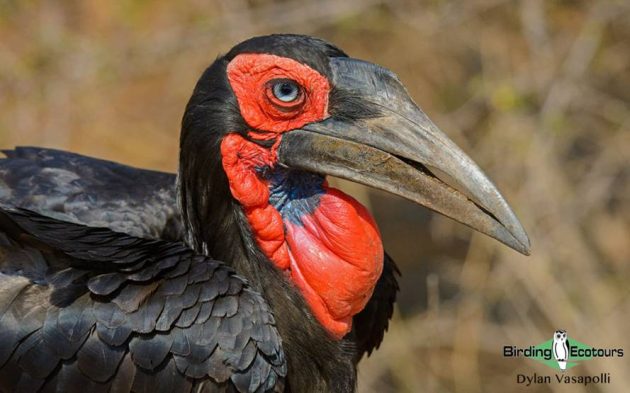
The Southern Ground Hornbill is one of Kruger’s iconic birds. Every visit to the park offers the chance to reconnect with familiar favorites while discovering something completely unexpected. (photo Dylan Vasapolli)
Although many people visit Kruger to see the Big Five, it is also one of Africa’s great birding destinations. From sought-after raptors to elusive river birds, every season offers something different and keeps birders coming back. It is also a wonderful place for bird photography, rewarding patient observers with unforgettable opportunities.
Although everyone experiences Kruger differently, one thing I can promise is that you will leave with memories that stay with you for a lifetime. Although no particular sighting is ever guaranteed, that uncertainty is exactly what makes the park so special. Time in Kruger goes far beyond adding species to a life list. Every encounter and every sighting become part of your story.
Those stories stay with you.
And before long, you find yourself planning the next trip.
Like I said, Kruger is the addiction that never gets satisfied.
















 English (US) ·
  French (CA) ·