

PROTECT YOUR DNA WITH QUANTUM TECHNOLOGY
Orgo-Life the new way to the future Advertising by Adpathway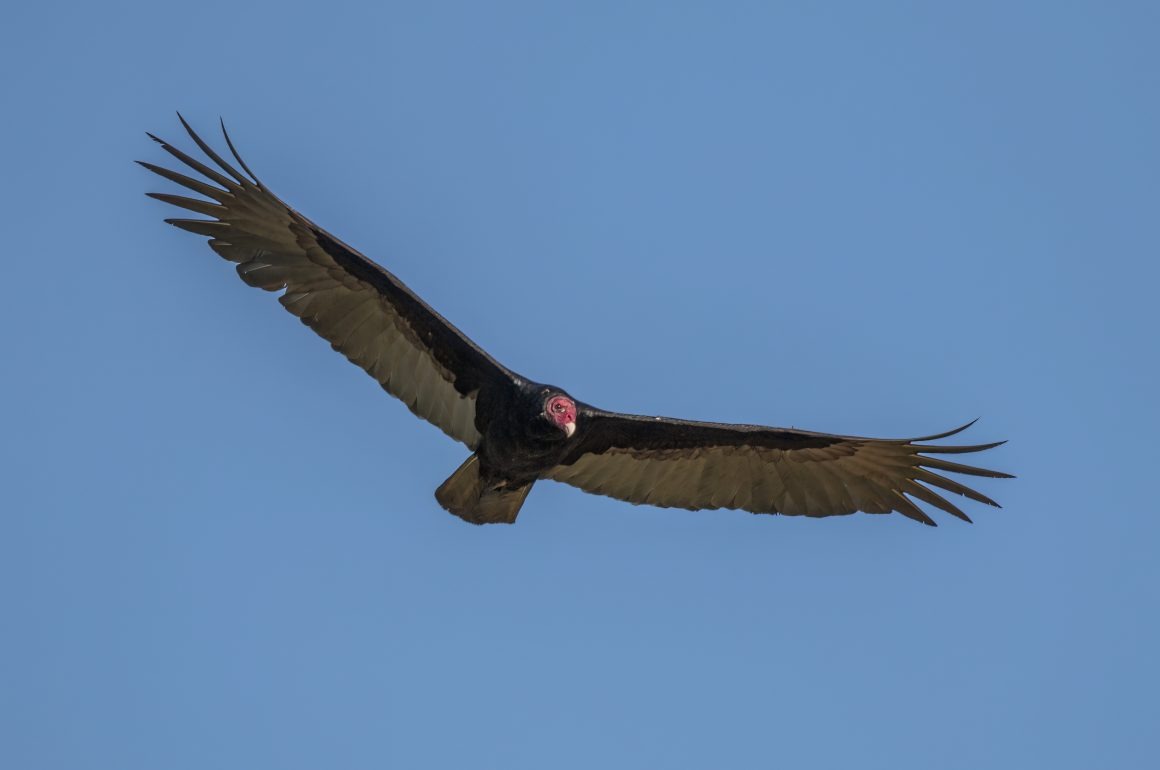
I know that the Turkey Vulture is not everyone’s favourite bird, but I admire them. Even to me, they aren’t very handsome looking, except in flight, when they gracefully soar upon the thermals. They are the carrion clean-up crew, getting rid of roadkill and other diseased carcasses, which could pose a health threat to us and other creatures.
While it is not considered a raptor (a bird that grasps its prey), it commonly hangs out with other birds of prey. The Turkey Vulture not only has keen eyesight, but also a strong sense of smell (unlike a lot of other birds, including Black Vultures), which allows it to find hidden carcasses. That’s why you will see Black Vultures following them. Turkey Vultures are the gentle folk of the vulture set. Younger birds defer to older, dominant birds at a carcass. There is no pushing or shoving, just an occasional hiss, when some bird forgets its manners.

I think of October as Turkey Vulture month, because that is when they start their migration. It can extend into December. They leave Canada and head to the Southern US and down into Central and South America.
Turkey Vultures are another migrant that avoids water crossings and uses thermals to fly south. They wait until mid-morning to take off and cease migration by late afternoon, when the thermals taper off.
In my opinion, they are the one migrant that does its utmost to avoid flapping. They catch a thermal, then use a rocking motion to keep moving. Turkey Vultures are very noticeable in the sky. They are almost eagle-sized. Their wings have a two-toned look underneath, and they hold them in a vee or dihedral position.

In the past, when a big group flew over our raptor watch, I would say it looked like an armada. Now, many of my fellow raptor watchers call out that another armada is coming.
Head to a raptor watch site on an October day with moderate northwest winds. Then prepare to be awed, as hundreds of these birds stream overhead. You may even be lucky enough to see a Golden Eagle or Black Vulture tagging along.
Note: All photos are from Wikipedia Commons, an online source of copyright-free photos: photo at top by Charles J. Sharp; next photo by Thomas Brown; bottom photo by KimonBerlin.

Written by Leslie Kinrys
Leslie Kinrys has loved birds, since her father put a House Sparrow fledgling in her young hands. She lives and birds in Toronto, Ontario, Canada, with some trips farther afield. She enjoys seeing all species of birds, but her favourites are hummingbirds. Also, Leslie enjoys reading, listening to Country music, getting together with friends, and rooting for her baseball team: the Toronto Blue Jays.
















 English (US) ·
  French (CA) ·