

 9 months ago
331
9 months ago
331
PROTECT YOUR DNA WITH QUANTUM TECHNOLOGY
Orgo-Life the new way to the future Advertising by AdpathwayChristmas cacti bring a stunning display to the indoor garden during the holiday season. The plant’s interesting segments and vibrant blooms provide a desirable aesthetic when placed among other holiday plants.
From its base needs to triggering blooming, all the way to propagation, it’s not hard for a beginner to care for Christmas cactus. As long as its conditions are right at the right times, it will pop off every year. After it blooms, you can use its prunings to multiply your collection or to give away as gifts.
For this beginner’s guide, we’ll cover the quick and easy Christmas cactus topics you need to understand to keep them happy. We’ll start with some basic info about holiday cactus identification, then we’ll turn to the right conditions for light, soil, and watering. We’ll even discuss how to trigger blooming.
Identifying Holiday Cacti
 Look for indicators in the leaf segments.
All holiday cacti are part of either the Schlumbergera or Rhipsalidopsis genus. These are epiphytic cacti, meaning in their natural state, they tend to grow on trees. Their roots attach to tree branches, and their lovely segmented leaves cascade downward in the rainforests of South America.
To grow a Christmas cactus as a beginner, first determine whether or not you actually have one in your possession. Holiday cacti all look alike, but they have marked differences. Look at the leaf segments. The slight variations between them are indications of which one you have.
Thanksgiving cacti (Schlumbergera truncata) have highly serrated leaves, whereas Easter cacti (Rhipsalidopsis gaertneri) have rounded segments. Christmas cacti (Schlumbergera x buckleyi) leaves are somewhere in between, with slightly serrated leaves that are also rounded.
If you find you’ve been sold another kind of cactus under the name Christmas cactus, don’t worry. It happens often, and many of the ‘varieties’ of this type of plant are actually hybrids of Thanksgiving cacti. The common name refers to the time of year it blooms, but the care is basically the same.
There are other ways to determine which one you’re growing, and we’ve got a comprehensive guide on that here.
Ideal Growing Conditions
 Indirect sun and regular watering keep these plants happy.
 In the wild, these plants grow under rainforest canopies and receive bright, indirect lighting. Ensure your cactus is away from direct sunlight, under the shade of trees outdoors, or offset from a south or west-facing window indoors. If you’re using a grow light, keep it out of the direct light.
To keep your cacti happy, formulate your own soil. They do best with a coarse soil that drains well, but also retains some moisture. This mimics the conditions they would naturally grow in. Here’s the formula for beginner Christmas cactus growers:
- 2-3 parts potting soil
- 2 parts coarse sand (use agricultural sand or agricultural grit)
- 1 part perlite
Wait until the soil is dry to the touch before watering. In most situations, every two to three weeks during the growing season is enough. You may need more water during the blooming phase. Once blooming completes, water less. Your cactus is dormant at this time.
To fertilize your cactus, use a liquid plant food diluted to half strength with water. A balanced fertilizer works for all parts of the growth cycle. If you want to get more specific, use a high nitrogen fertilizer ahead of blooming, and about a month before blooming, switch to one higher in potassium and phosphorus.
Keep your cacti in an area of your home that doesn’t dip below 60°F (16°C). When it’s time to help your cactus bloom, it needs an area with nighttime temperatures around 55 to 65°F (13-18°C). Keep the container away from drafts and from drying air from a vent. Keep its conditions as consistent as possible. Drastic changes cause leaf and bud drop.
How to Trigger Blooming
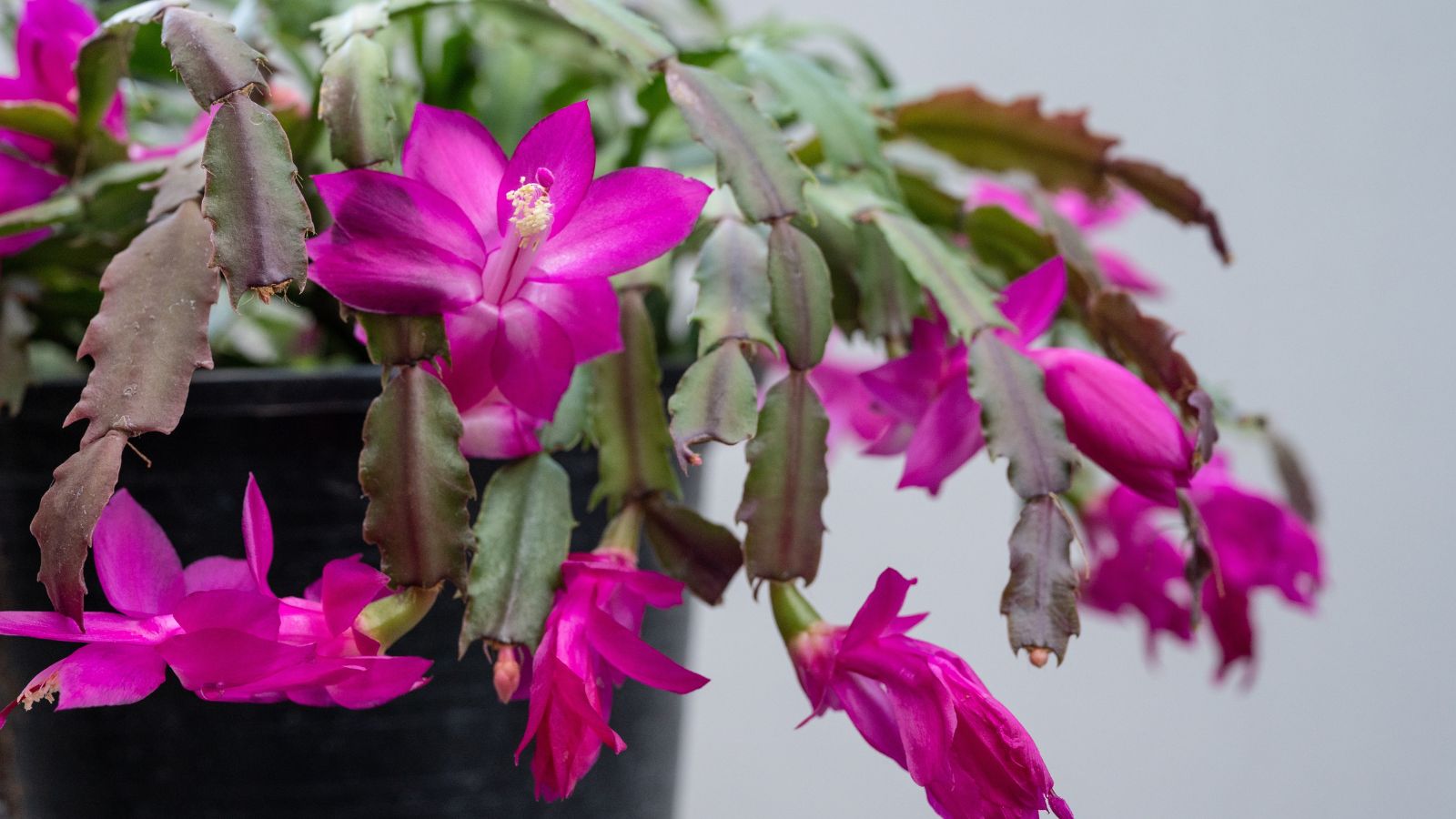 Controlling light and temperature is key to promoting flowering.
 The trickiest part of growing these plants is augmenting their conditions when it’s time for them to bloom. If you don’t do this, you may not see as many blooms on your Christmas cactus. It’s a typical beginner Christmas cactus growing mistake we’ll prevent right here.
In the wild, these plants receive reduced light and temperatures in the rainy seasons, which helps them set buds. In September, give them nighttime temperatures of 55 to 65°F (13-18°C), and at least 13 hours of darkness each day. Use a blackout curtain, a cardboard box, or place your cactus in a closet during this time.
Once you have bud set, return the cactus to its normal conditions, with an ideal temperature range around 70°F (21°C). This warmer temperature prompts the incredible blooms this cactus is known for.
Pruning and Repotting
 Remove damaged areas to promote new growth.
 Once your cactus finishes blooming, prune it! Snip the tips of your cactus branches throughout spring. Avoid pruning in the summer, as this can limit blooming. When you snip, use sharp, sterilized pruners and cut between leaf segments. The result is a bushier plant with more blooms next season.
Any time your cactus shows signs of stress, prune its tips back to healthy, green growth. Leaves exposed to excessive light will turn brown and crispy. Waxy, limp leaves are likely caused by watering issues. In this case, prune back to healthier growth and repot your cactus.
Repot your cactus if it has succumbed to any watering issues or improper soil conditions. It’s also a good thing to do when your cactus is too large for its pot. If you notice it doesn’t take in water as much, or doesn’t grow new leaves, it needs a new container. Choose one an inch or two larger than the current one.
When you repot, dust off the soil from the root mass and inspect it, looking for any rotten or tangled roots. Remove browned root segments with your sterile pruners, and gently loosen the mass with your hands. Then place the cleaned-up plant in its new container.
Key Takeaways
As long as you give it the right conditions, your cactus can live for up to 100 years! Keep it in bright, indirect light, in temperate conditions. Water the soil when it is dry to the touch. Feed your cactus bi-weekly, and put it in the dark with cooler conditions to help it bloom.
After the blooms fade, prune your cactus and start new ones. Use the spring to do any necessary repotting and propagate new cacti for friends and family.














 English (US) ·
  French (CA) ·