

 9 months ago
372
9 months ago
372
PROTECT YOUR DNA WITH QUANTUM TECHNOLOGY
Orgo-Life the new way to the future Advertising by AdpathwayWhen it’s time to protect potted plants, cold weather can be a threat, but it’s not a death sentence. Experienced gardener Sarah Jay covers all the ways you can protect your outdoor plants in containers. There are multiple methods to help outdoor container plants survive.

Written by Sarah Jay Last updated: November 25, 2025 | 3 min read
In late fall, the first frost rolls through my region, and it’s time to assess how I’ll protect potted plants from cold. Cold weather can make or break some plants, but others handle it with some simple reinforcements. Without taking action ahead of the freeze, I could lose some plants.
Gardening is trial and error, leading to the right actions that ensure we can nurture plants for years to come. If we don’t have a shelter or if we’re low on indoor space, we have to adapt and find other ways to keep our plants alive through more extreme conditions.
Potted plants are more sensitive to the elements when compared to in-ground plants. While the container they’re planted in does safeguard, the fact that the soil is not in the ground and insulated leaves them open to damage and vulnerable to quick shifts in climate.
Start by watering your plants regularly, especially before a freeze. Keep those tropicals indoors when nighttime temperatures are consistently below 55°F (13°C). This list is designed to help you keep root-hardy perennials alive through cold.
Epic GardenBox Greenhouse
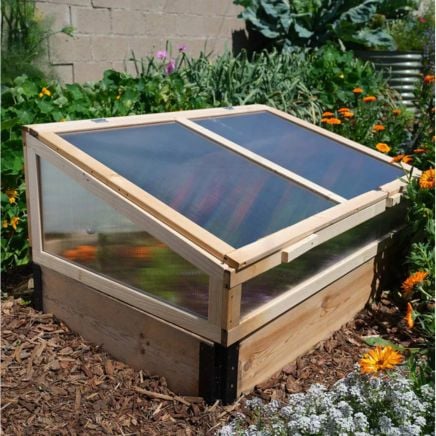
Epic GardenBox Greenhouse

Epic GardenBox Frost Cover
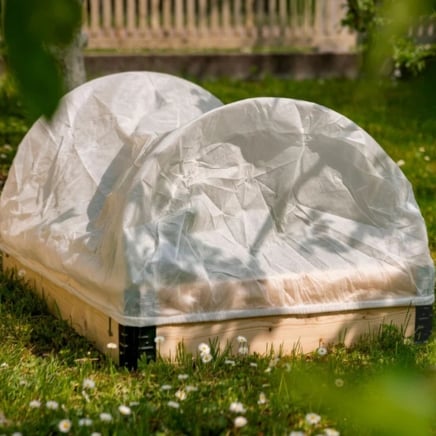
Epic GardenBox Frost Cover
Group Plants Together
 Plants share warmth when they’re placed together.
 Your first line of defense is to group your container plants together. Get them as close as possible, and you’ll protect potted plants – cold weather notwithstanding! If you have room to bring them toward your home, you’ll reinforce their ability to survive.
South-facing walls receive the most sunlight in the northern hemisphere, and north-facing walls are the warmest in the southern hemisphere. Plants share warmth when they’re placed together.
Bolster this tendency by stuffing the spaces between plants with fallen leaves, evergreen boughs, or even burlap. We’ll touch on coverings in more detail later in this piece, but wrapping the entire collection of potted plants with a sheet or burlap adds even more shielding.
Mulch
 A layer of mulch insulates the soil and protects the roots.
Just as mulch protects plants in the ground, it’s also a great way to protect potted plants. Cold soil is less likely in mulched plants, and while the container is above the ground and somewhat exposed to the elements, it helps! Use organic mulches for the best results, and as a source of nutrients through winter.
Straw, leaves, wood chips, bark, nut hulls, and even evergreen branches are all viable options. A layer of at least two inches will prevent water evaporation from drying winter winds and insulate the soil. It also prevents germination of pesky perennial weeds when it warms up in spring.
Find an Outdoor Shelter
 Protective covers are great for extending the season.
 If you have access to a greenhouse or a cold frame, throw your plants in there! To adequately protect potted plants, cold frames and other outdoor shelters need a good seal. If you have access to climate controls, like vents and air conditioning, even better. These kinds of shelters protect even your most sensitive tropicals when oriented correctly.
If you don’t have access to specialized tech to protect potted plants from cold, buy or construct a cold frame. For a sustainable option, repurpose old windows and doors, or sheets of greenhouse plastic. Place a cold frame cabinet on the side of the house that receives the most sunlight to provide the most warmth.
When temperatures rise above 50°F (10°C), open the cold frame to ensure plant leaves don’t get singed. If you know cold is coming again, simply vent the frame, then close it when the air cools down. To boost the inner temperature, employ a string of incandescent lights. Set these on a timer to turn them off manually when you don’t need the extra heat.

Provide Windbreaks
 Winter winds are incredibly damaging to sensitive plants.
 Drying winds are the most damaging of the elements when it’s time to protect potted plants from cold. Cold-hardy plants in containers can be at great risk on a frigid and windy day. Even the most cold-resistant plants will take on damage in high winds. This is where windbreaks come in.
Use established structures in your garden to block the wind. The side of your house is a perfect windbreak, but if that’s not an option, a hedge or line of trees works. A stone fence, or garden wall, works too as long as it is sturdy and won’t fall in a wind storm.
Cover Them
 Frost cloth or greenhouse plastic limits damage to stems and leaves.
 A combination of all of the above will protect potted plants from the cold. Extreme cold requires another layer of protection (pun intended). Group your containers together, wrap their base, and place them near a windbreak or close to your home in the sun. Then cover them.
There are different ways to do this. Using something as simple as an old sheet or towels will protect your potted plants from cold. Frost cloth is a good option, but it doesn’t keep plants warm as much as greenhouse plastic does. Greenhouse plastic is highly effective when sealed properly, but should be removed when temperatures are 50°F (10°C) or higher.
In deep freezes, I’ll use a combination of sheets and towels topped with greenhouse plastic. This is the strategy I find best protects my plants when there’s a high chance of high winds, precipitation, and freezing air. As soon as the direct sun hits them and the air warms up, I remove the plastic. The sheets remain as long as the temperature is not too warm.

















 English (US) ·
  French (CA) ·