

 9 months ago
298
9 months ago
298
PROTECT YOUR DNA WITH QUANTUM TECHNOLOGY
Orgo-Life the new way to the future Advertising by AdpathwayFiddle leaf figs have earned a reputation as drama queens of the houseplant world, and honestly, it’s well-deserved. These plants seem to shed leaves over the smallest environmental changes, leaving their owners panicking and wondering what they did wrong.
And half the time, it’s not even anything drastic you did. They are just that fussy.
The frustrating part is that leaf drop can have multiple causes, and figuring out which one is affecting your plant takes some detective work. The good news is that most causes are fixable if you catch them early enough.
Let’s look at the most common reasons your fiddle leaf fig is dropping leaves and what you can do about it.
You Moved It
 These houseplants don’t respond well to changes in conditions.
 Fiddle leaf figs hate being moved. And this is not rotating the pot occasionally for even growth. I mean significant location changes like moving from one room to another, bringing it home from the nursery, or even just shifting it several feet to a different spot.
These plants are incredibly sensitive to environmental changes. When you move a fiddle leaf fig (or any ficus), it experiences shifts in light levels, temperature, humidity, and air circulation all at once. The fiddle leaf fig responds to this stress by dropping leaves, often starting with the older, lower leaves first. It’s the plant’s way of conserving energy while it adjusts to the new conditions.
Unfortunately, there’s not much you can do once the leaf drop starts except wait it out. The key is preventing it in the first place by choosing your plant’s location carefully from the start and committing to leaving it there. If you absolutely must move your fiddle leaf fig, try to match the conditions of its previous location as closely as possible.
Some leaf drop after bringing a new plant home is normal and expected. The shift from greenhouse conditions to your home environment is significant, and most fiddle leaf figs will start dropping leaves during this adjustment period. As long as the plant isn’t losing more than one or two leaves per week and you see new growth emerging from the top, it should recover fine.
Watering Issues
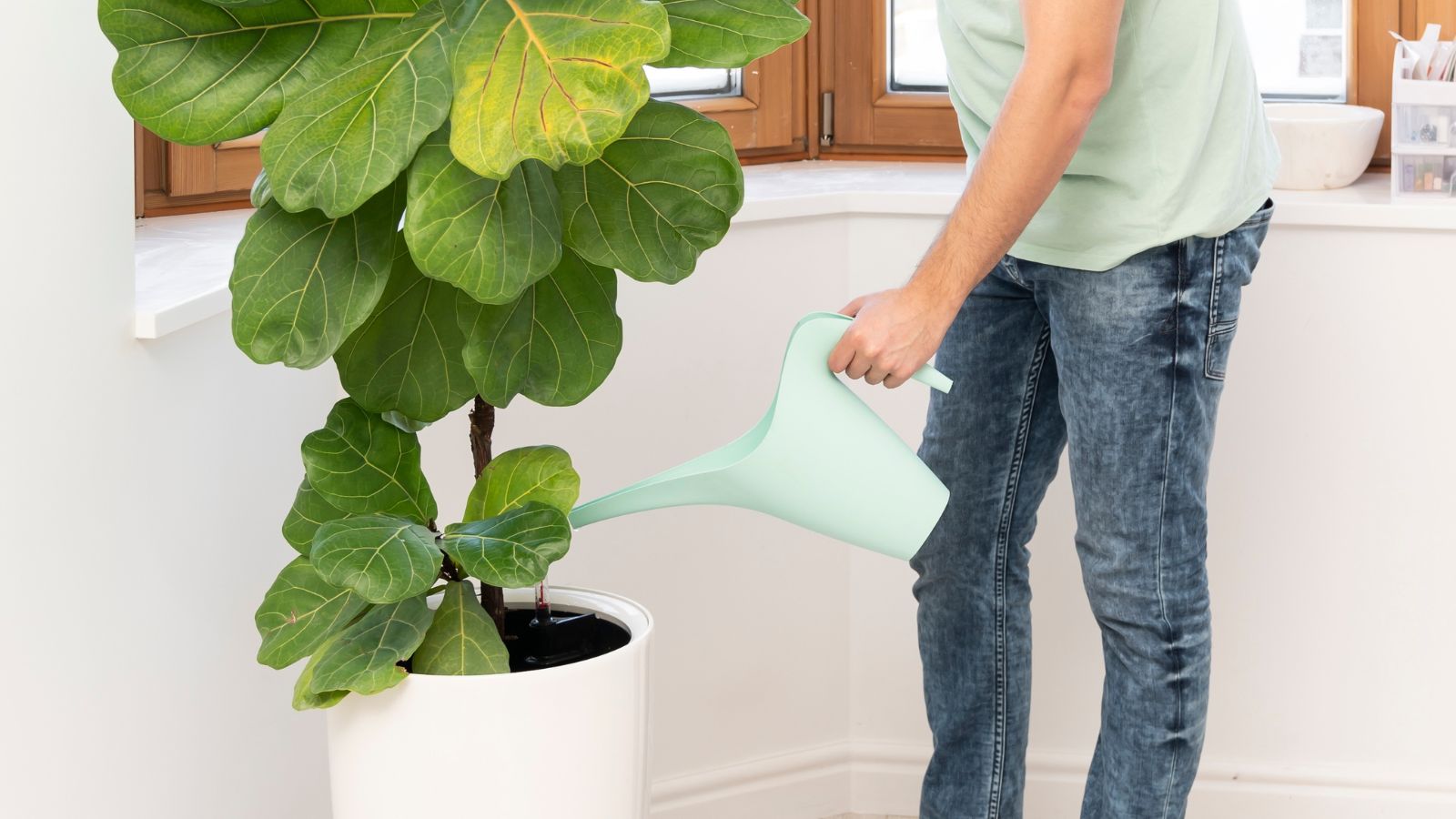 Incorrect watering leads to stress and leaf drop.
 Watering problems are probably the most common cause of fiddle leaf figs dropping leaves. Both overwatering and underwatering can trigger it, though they show up slightly differently.
Overwatering causes leaves to turn yellow before dropping, often starting with the lower leaves. The yellowing happens because waterlogged soil prevents roots from accessing oxygen, and damaged roots can’t deliver nutrients properly. You might also notice the leaves feel soft or droopy before they fall, and the soil stays wet for days after watering.
Underwatering leads to brown, crispy edges on leaves that eventually drop off entirely. The plant essentially sheds leaves that it can no longer support with limited water resources. Underwatered fiddle leaf figs often have dry soil pulling away from the pot, and the leaves may feel papery or brittle.
The fix depends on which problem you’re dealing with. For overwatering, let the soil dry out significantly before watering again, and check that your pot has adequate drainage holes. You may need to repot into fresh, well-draining soil if root rot has set in.
For underwatering, establish a more consistent watering routine and make sure you’re watering thoroughly when you do water.
Test the soil before watering by sticking your finger into the top few inches. Water when that top layer feels dry, but before the entire pot dries out completely. Fiddle leaf figs prefer soil that stays lightly moist but never soggy.
Pests
 Scale insects are common problems indoors.
 Pests are sneaky culprits that often go unnoticed until significant damage has occurred. Spider mites, scale, and mealybugs all target fiddle leaf figs, sucking sap from the leaves and weakening the plant. As the infestation progresses, affected leaves turn yellow or brown and eventually drop off.
Spider mites are particularly problematic because they’re tiny and hard to spot without close inspection. Look for fine webbing on the undersides of leaves or between the leaf and stem. The leaves may also develop a stippled, dusty appearance before they drop.
Scale insects look like small brown bumps along the stems and leaf veins. They don’t move much, so people often mistake them for part of the plant. Mealybugs appear as white, cottony clusters in leaf axils and along stems.
Check your fiddle leaf fig regularly for pests, especially if it’s dropping leaves without an obvious watering or environmental cause. Inspect the undersides of leaves carefully, as that’s where most pests hide. If you catch an infestation early, you can often control it with insecticidal soap or neem oil applied according to package directions.
Isolate affected plants from other houseplants to prevent the pests from spreading. This is especially important with spider mites, which can quickly move to neighboring plants.
Incorrect Light Levels
 Lack of sunlight is one of the most common causes of leaf drop.
 Fiddle leaf figs are surprisingly particular about light. They need bright, indirect light to thrive. Not low light like many people assume, but not harsh direct sun either. When light levels are wrong, the fiddle leaf fig responds by dropping leaves.
Too little light is the more common problem. In dimly lit rooms, fiddle leaf figs can’t photosynthesize efficiently and start shedding older leaves to reduce their energy demands. You might notice the plant becomes leggy, with long spaces between leaves and weak, thin growth before the leaf drop begins.
Too much direct sun, particularly harsh afternoon sun, can scorch leaves. Burned leaves typically develop brown patches or crispy edges before falling off. The damage usually affects leaves that receive the most direct light first.
The ideal spot for a fiddle leaf fig is near a bright window with sheer curtains to filter intense light, or a few feet back from an unobstructed window. East or west-facing windows work well, providing gentle morning or afternoon light. South-facing windows can work too if the plant is positioned back from the glass or if you use window treatments to diffuse the light.
If you’ve recently moved your plant to a new location with different light levels, that could explain the leaf drop. Give it time to adjust and avoid moving it again while it’s recovering.
Lack of Root Space
 Repot smaller trees often to provide more root space.
 Fiddle leaf figs eventually outgrow their containers, and when they do, several problems develop that can lead to leaf drop. Root-bound plants can’t absorb water efficiently because there’s more root than soil, meaning the limited soil dries out too quickly. Nutrients become depleted as well, since there isn’t enough soil to hold adequate nutrition.
Check if your plant is root-bound by looking at the drainage holes. If you see roots growing through the holes or circling around the outside of the root ball, it’s time to repot. Another sign is water running straight through the pot without being absorbed, or the plant needing water much more frequently than it used to.
Repot into a container that’s 2 to 4 inches larger in diameter than the current pot. Going too much bigger can actually cause problems, as excess soil holds moisture that the roots can’t access, potentially leading to overwatering issues. Use fresh, well-draining potting mix formulated for houseplants or make your own by mixing regular potting soil with perlite.
Spring is the best time to repot, as the plant is entering its active growing season and will recover more quickly from the disturbance. Expect your fiddle leaf fig to start dropping leaves after repotting anyway, as this counts as a major environmental change. As long as you see new growth within a few weeks, the plant is adjusting fine.
Old Soil
 Soil degrades over time, unable to hold moisture.
 Even if your fiddle leaf fig isn’t root-bound, old soil can cause problems that lead to leaf drop. Over time, potting mix breaks down and becomes compacted. This compaction reduces drainage and air circulation around the roots, creating conditions similar to overwatering (even if you’re watering correctly).
Old soil also becomes depleted of nutrients. While you can supplement with fertilizer, degraded potting mix doesn’t hold or deliver nutrients as effectively as fresh soil. The plant struggles to access what it needs for healthy growth. Your fiddle leaf fig may start dropping leaves as resources become limited.
If your fiddle leaf fig has been in the same soil for more than two years, consider refreshing it even if the plant isn’t root-bound. You can either repot into the same container with fresh soil or move up one pot size if the roots are getting crowded.
When repotting, gently loosen the root ball to remove old soil and encourage roots to spread into the fresh mix. Be careful not to damage too many roots in the process, as this can cause additional stress and more leaf drop.
After repotting with fresh soil, hold off on fertilizing for about a month. New potting mix contains nutrients, and adding fertilizer too soon can overwhelm the plant while it’s already stressed from the repotting process. Once the plant has adjusted and you see new growth, you can resume a regular fertilizing schedule during the growing season.















 English (US) ·
  French (CA) ·